- move some larger vars into a nested scope.
- replace memset with zero initializer.
- rempace VECCOPY macros with copy_v3v3
- change function args to give the float array length.
- continue zoom now uses the same options as dolly (hoz/vert & invert).
- remove event mouse coord hack to bypass touchpad zoom invert, instead pass invert as an argument.
for sampling were not consistent, now the RNG is seeded per strand, and some
tweaks were done to make the jittered sampler cache return consistent sample
numbers for strands.
These should not have any effect on render results, except in some cases with
you have overlapping faces, where the noise seems to be slightly reduced.

There are some performance improvements, for simple scenes I wouldn't expect
more than 5-10% to be cut off the render time, for sintel scenes we got about
50% on average, that's with millions of polygons on intel quad cores. This
because memory access / cache misses were the main bottleneck for those scenes,
and the optimizations improve that.

Interal changes:

* Remove RE_raytrace.h, raytracer is now only used by render engine again.
* Split non-public parts rayobject.h into rayobject_internal.h, hopefully
 makes it clearer how the API is used.
* Added rayintersection.h to contain some of the stuff from RE_raytrace.h
* Change Isect.vec/labda to Isect.dir/dist, previously vec was sometimes
  normalized and sometimes not, confusing... now dir is always normalized
  and dist contains the distance.
* Change VECCOPY and similar to BLI_math functions.
* Force inlining of auxiliary functions for ray-triangle/quad intersection,
  helps a few percentages.
* Reorganize svbvh code so all the traversal functions are in one file
* Don't do test for root so that push_childs can be inlined
* Make shadow a template parameter so it doesn't need to be runtime checked
* Optimization in raytree building, was computing bounding boxes more often
  than necessary.
* Leave out logf() factor in SAH, makes tree build quicker with no
  noticeable influence on raytracing on performance?
* Set max childs to 4, simplifies traversal code a bit, but also seems
  to help slightly in general.
* Store child pointers and child bb just as fixed arrays of size 4 in nodes,
  nearly all nodes have this many children, so overall it actually reduces
  memory usage a bit and avoids a pointer indirection.
* Tracing objects with IOR < 1.0 (like air bubbles under water) wasn't working correctly as a refraction was always assumed to be the first thing that happens for transparent materials.
* This fix is ok, but the fact that the internal renderer is not a physically based one is starting to show, as for example blurred reflections in this case are not really possible nicely without some slightly heavier modifications to the ray code.
* Also some cleaned up logic and better comments for my previous total internal reflection commit.
* This was wrong since 2006!
* Raytrace code assumed refractions to go "air -> glass -> air -> glass -> air.." so actually only the first total internal reflection was calculated correctly, but everything after that was wrong.
* Now after a total internal reflection there needs to be an actual refraction before the ray escapes the "glass" object.
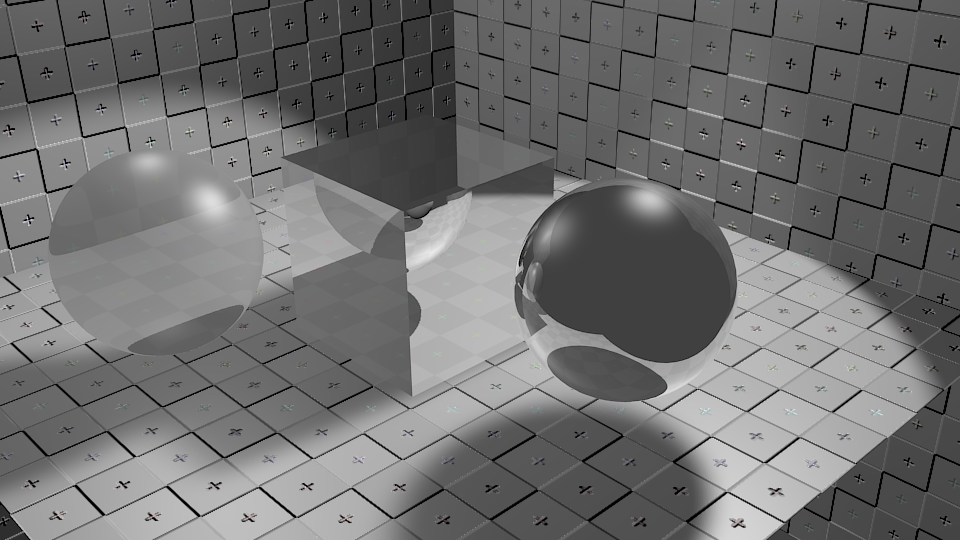
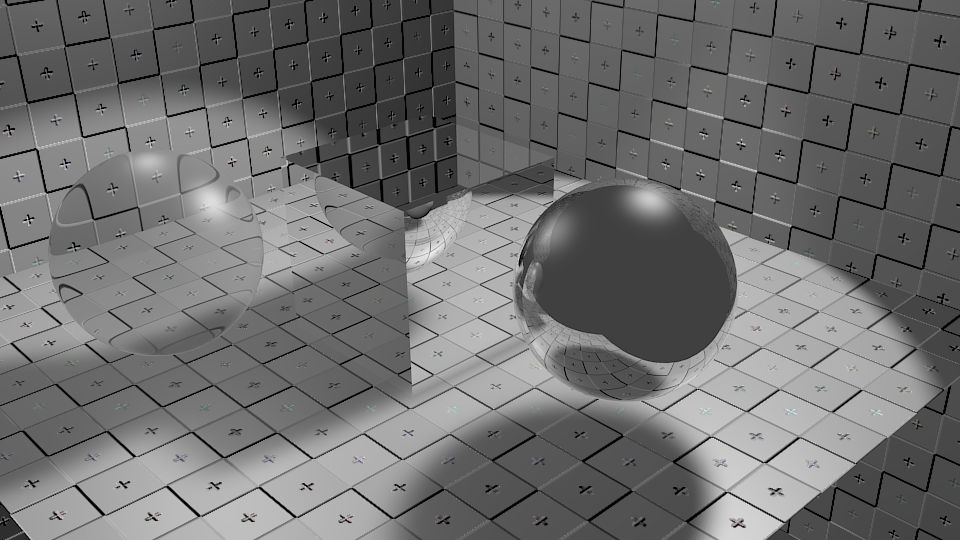
Raytracing didn't show soft shadow in reflections, nor did it do any
derivative even. Added a basic version for it in raytracer now, still
needs improvement on heavily curved surfaces. But it's better!

Examples:

Glass sphere, mirror cube and sphere, look how it ignores bump and shadow
http://www.blender.org/bf/derivative256.png

in svn now:
http://www.blender.org/bf/derivative-svn.png
by default now on all platforms since it shouldn't crash anymore if SSE is
not there. If this breaks compilation on some platforms, please let me know.
mask, also avoid making vertex groups if they will not be filled.
* Add back image pin option in image editor header.
* Fix deep shadow not respecting Cast Buffer Shadows option.
* Tangent space normal map baking should work again now.
* Fix a problem with particle duplis, due to own bugfix for #20350,
  the problem for that seems to be in dupliverts, not particles.
* Fix external multires data link getting lost on exiting editmode.

(commits 27776,27777,27830,27840,27841,27862 by Brecht from render25 branch)
Ambient occlusion: multiplied with direct lighting by default, add
is also still available and more blending methods might be added if
they are useful. This is fundamentally a non physical effect.

Environment lighting: always added as you would expect (though you can
subtract by specifying negative energy). This can be just white or take
colors or textures from the world.

Indirect lighting: only supported for AAO at the moment (and is still
too approximate), and also is always added. A factor is available to
specify how much is added, though value 1.0 is correct.

Also:
* Material ambient value now defaults to 1.0.
* Added Environment, Indirect and Emit pass.
* "Both" blending method is no longer available.
* Attenuation, sampling parameters are still shared, some could be split
  up, though if they are different this would affect performance.