Previously [D16255](https://developer.blender.org/D16255)
There is no option to adjust the edge_width like there is in the preferences for vertex_size and face_dot_size.
I only added the option for 3DView and UV/Image Editor, and limited both to a max size of 5 pixel, since the edges do not look very nice with too high values.
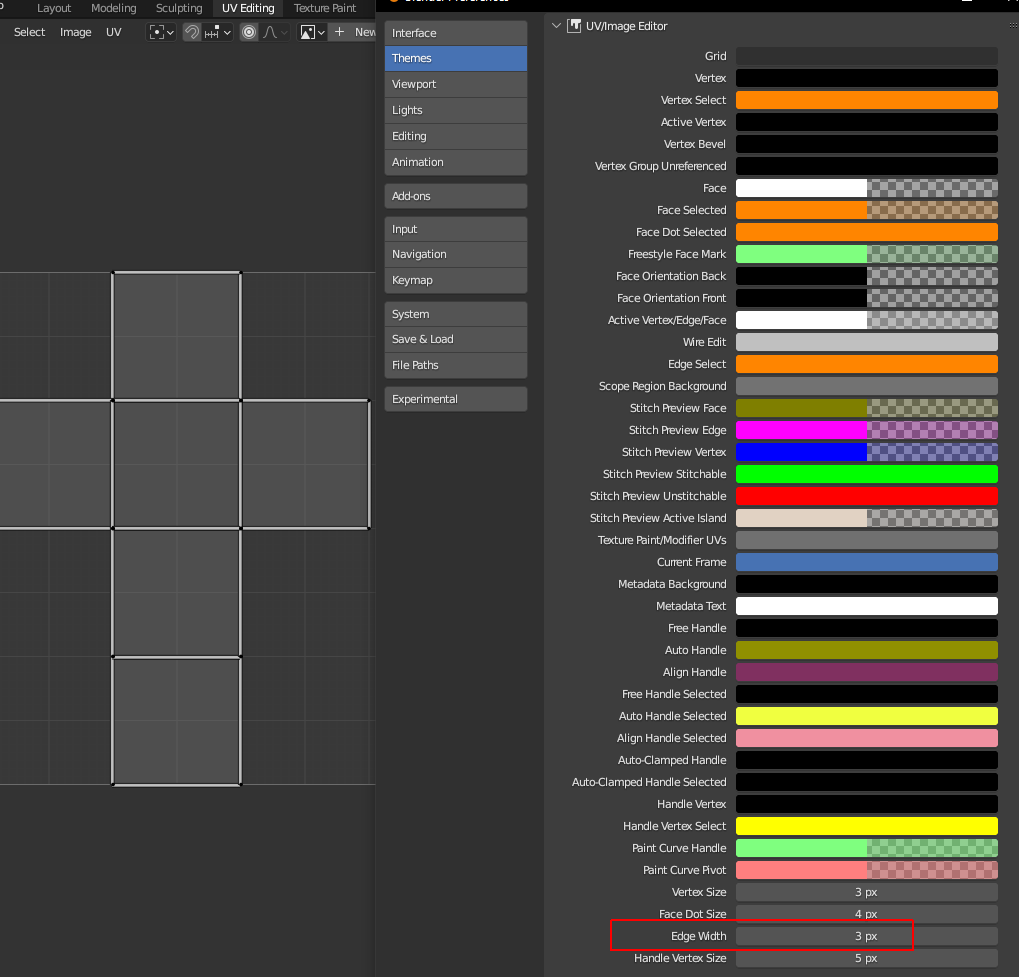
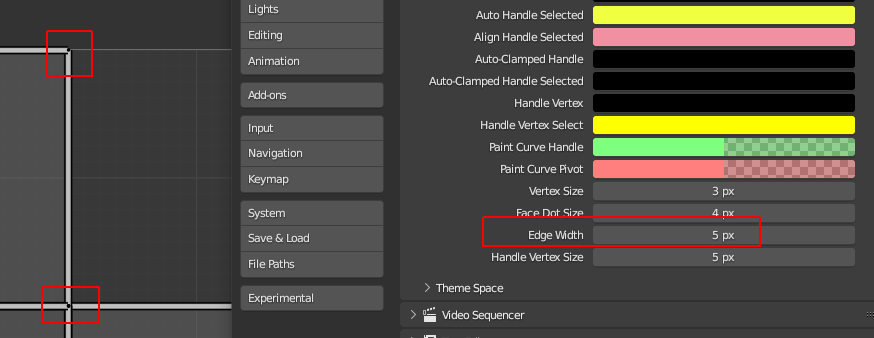
In the UV Editor only, there are always black outlines on the edges, I could not find a way to reduce the increasing thickness of these black outlines.
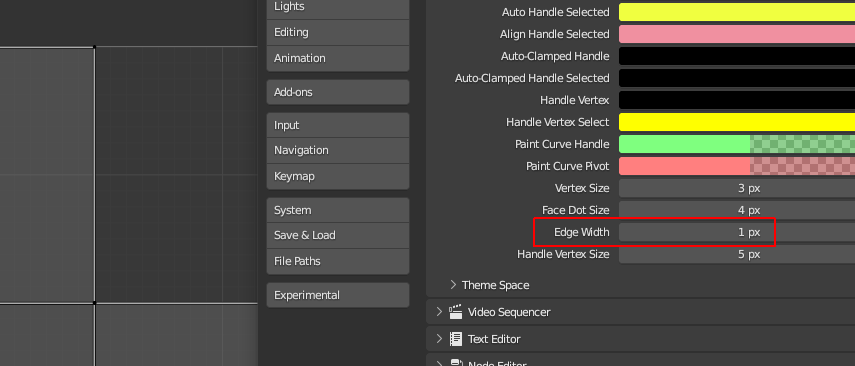
The default edge_width of 1 pixel:
Here the edge_width with a falue of 3:
And here the visible increase of the dark border of the edges and their overlap (even at the maxed size of 5):
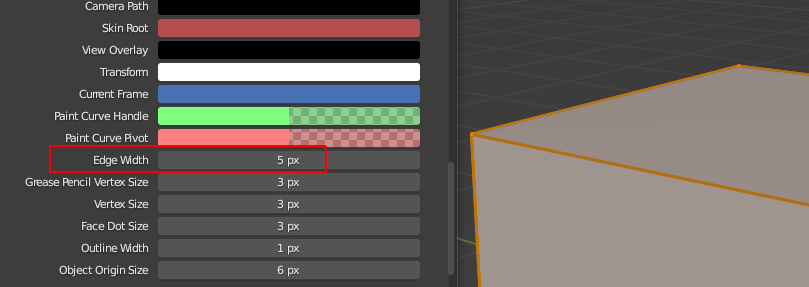
Lastly for the 3DView the max edge_width of 5 looks like this:
Pull Request #104741
No behavior change intended.

Many file drag & drop handlers used the icon assigned for dragging to
determine what type of data is dragged. This is fragile, for example
changing an icon would break drag & drop (!). This happened a few times,
e.g. see 3788003cda. It's also causing problems with #104830, which
changes how file browser drag data is handled.

Instead use the file extension to determine the file type.
Exiting curves edit mode (going to object mode) would not update the
screen.

The fix adds a case to `ED_object_editmode_load_free_ex` for CURVES
to make sure the function returns properly. This then correctly adds the
notifier in `ED_object_editmode_exit_ex` to update the screen.

Pull Request #105252
- "Value" in the sense of color lightness is not the same word in
  Japanese as other usages. See #105113.
- "Double" as a data type vs. a value.

Also extract "Custom Color Presets" in the tracking UI.
Run clang-format as well.

Pull Request #105187
Actually is impossible to filter the Grease Pencil object type in the Outliner because only Meshes, Cameras and Lights are supported. This patch adds the Grease Pencil filter that allows artists to select only this type of objects. This filter is very handy for storyboarding.

Pull Request #104473
This commit adds the default .usdz export capability.

The importer already supports usdz so no change is required other than updating the text in menu to match the updated exporter text.

On export, a .usd/a/c file has to be created first, and then converted to .usdz. A weird change of directory is required because of a quirk with the USD conversion to usdz. If an absolute filepath is passed into the `UsdUtilsCreateNewUsdzPackage` function, the usd files inside the usdz archive will have the same directory structure, i.e. if one tries to create a file at `C:\code\BlenderProjects\file.usdz`, when the usdz file is created, inside it will have the structure `\code\BlenderProjects\file.usdc`.

This is counteracted by setting the current working directory to the temporary session directory where both the usdc and usdz files are created, and just passing the file name to `UsdUtilsCreateNewUsdzPackage` without any filepath. Once the usdz file is created it is moved to the intended directory.

There is a separate `UsdUtilsCreateNewARKitUsdzPackage` capability for exporting usdz for iOS devices that will be implemented in a follow up patch as it will require some more small UI changes.

Co-authored-by: Charles Wardlaw (@CharlesWardlaw)
Co-authored-by: Sonny Campbell (@SonnyCampbell_Unity)
Co-authored-by: Bastien Montagne (@mont29)

Pull Request #105185, based on #104556.

Pull Request #105223
* Refactored the color filter op to have an ->exec callback.
* Added nullptr checks to the filter cache API to support
  running outside of a view3d context.
* Redo panel displays the active filter type's name in the
  header.
This commit adds the default .usdz export capability.

The importer already supports usdz so no change is required other than updating the text in menu to match the updated exporter text.

On export, a .usd/a/c file has to be created first, and then converted to .usdz. A weird change of directory is required because of a quirk with the USD conversion to usdz. If an absolute filepath is passed into the `UsdUtilsCreateNewUsdzPackage` function, the usd files inside the usdz archive will have the same directory structure, i.e. if one tries to create a file at `C:\code\BlenderProjects\file.usdz`, when the usdz file is created, inside it will have the structure `\code\BlenderProjects\file.usdc`.

This is counteracted by setting the current working directory to the temporary session directory where both the usdc and usdz files are created, and just passing the file name to `UsdUtilsCreateNewUsdzPackage` without any filepath. Once the usdz file is created it is moved to the intended directory.

There is a separate `UsdUtilsCreateNewARKitUsdzPackage` capability for exporting usdz for iOS devices that will be implemented in a follow up patch as it will require some more small UI changes.

Co-authored-by: Charles Wardlaw (@CharlesWardlaw)
Co-authored-by: Sonny Campbell (@SonnyCampbell_Unity)
Co-authored-by: Bastien Montagne (@mont29)

Pull Request #105185, based on #104556.
Resolves issue with nearest filtering on UI Icons. Note that as
Metal does not support LOD bias as a parameter on a sampler
object, the original code has been modified to perform LOD
biasing at the shader level.

As GPU_SAMPLER_ICON is not  widely used, it is more
efficient to apply directly to the  affected shaders, rather
than workaround passing in the sampler LOD bias as a
separate value e.g. uniform or push constant.

Original PR feedback addressed to also refactor ICON
shaders to use consistent style for single and multi
Icon rendering.

Authored by Apple: Michael Parkin-White

Ref #96261
Pull Request #105145
After 7eda9d8dda, crash occurs when operation search is called and no
active tree element is present. Add missing null check in new poll
function to fix the crash.

Pull Request #105004
Zero-sized gizmos were not shown because GPU does not draw filled
triangles with zero area. This problem is resolved by drawing lines or
points in these degenerated cases.
Scaling is supported via computing the original and the new size, then
treat the case with zero original size separately, instead of only
computing the scale itself.
Actually applies to all `cage2d` gizmos, but not compatible when
translate flag is set.
After 49ad91b5ab, an extra visibility
toggle is being drawn for grease pencil layer in dopesheet. In this PR,
a condition is added to skip drawing of visibility toggle for GPencil
layer. Also, Grease pencil does not support pinning so restore the offset
added to channel for drawing the pin icon.

Pull Request #105080
This was actually caused by two problems.  The first is that the
    code actually deliberately detects if nothing happened and pushed
    an undo step, a bugfix for a problem that no longer exists.

    The second was that SCULPT_test_location sometimes does a closest
    point search instead of ray casting and didn't check the result
    against the brush radius.
In 6514bb05ea I misinterpreted the function's intended
behavior when there was already an existing active layer. The data from
the active layer is just meat to be copied, the function should always
add a new attribute.
Blender currently has 2 algorithms for merging vertices:
- `BKE_mesh_merge_verts`;
- `blender::geometry::create_merged_mesh`

`BKE_mesh_merge_verts` has a simplified algorithm to work with Array,
Mirror and Screw modifiers. It doesn't support merge results that would
create new faces. However it has shortcuts to be more efficient in
these modifiers.

`blender::geometry::create_merged_mesh` tries to predict all possible
outcomes. So it's a more complex. But it loses in performance to
`BKE_mesh_merge_verts` in some cases.

The performance comparison between these two depends on many factors.
`blender::geometry::create_merged_mesh` works with a context that has
only the affected geometry. Thus a smaller region of the mesh is read
for duplicate checking. Therefore, the smaller the affected geometry,
the more efficient the operation.

By my tests `blender::geometry::create_merged_mesh` beats
`BKE_mesh_merge_verts` when less than 20% of the geometry is affected
in worst case `MESH_MERGE_VERTS_DUMP_IF_EQUAL` or 17% in case of
`MESH_MERGE_VERTS_DUMP_IF_MAPPED` .

For cases where the entire geometry is affected, a 30% loss was noticed,
largely due to the creation of a context that represents the entire mesh.

Co-authored-by: Germano Cavalcante <germano.costa@ig.com.br>
Pull Request #105136
When using the frame channel operators from #104523
the framing would fail under the following circumstance.
* In the graph editor
* Using normalized view
* with a curve that has a y-extent of less than the focus threshold of 0.01

The issue was the the clamping code was
before the normalization multiplication.

Pull Request #105121
When using the "Frame Channel" operator in the Dope Sheet
the view would always go back to the top.

Fix it by copying the y bounds when in the Dope Sheet.

Pull Request #105123
Using spans instead of raw pointers helps to differentiate ararys from
pointers to single elements, gives bounds checking in debug builds, and
conveniently stores the number of elements in the same variable.

Also make variable naming consistent. For example, use `loops` instead
of `mloop`. The plural helps to clarify that the variable is an array.

I didn't change positions because there is a type mismatch between
C and C++ code that is ugly to manage. All remaining code can be
converted to C++, then that change will be simpler.

Pull Request #105138


