These should not have any effect on render results, except in some cases with
you have overlapping faces, where the noise seems to be slightly reduced.

There are some performance improvements, for simple scenes I wouldn't expect
more than 5-10% to be cut off the render time, for sintel scenes we got about
50% on average, that's with millions of polygons on intel quad cores. This
because memory access / cache misses were the main bottleneck for those scenes,
and the optimizations improve that.

Interal changes:

* Remove RE_raytrace.h, raytracer is now only used by render engine again.
* Split non-public parts rayobject.h into rayobject_internal.h, hopefully
 makes it clearer how the API is used.
* Added rayintersection.h to contain some of the stuff from RE_raytrace.h
* Change Isect.vec/labda to Isect.dir/dist, previously vec was sometimes
  normalized and sometimes not, confusing... now dir is always normalized
  and dist contains the distance.
* Change VECCOPY and similar to BLI_math functions.
* Force inlining of auxiliary functions for ray-triangle/quad intersection,
  helps a few percentages.
* Reorganize svbvh code so all the traversal functions are in one file
* Don't do test for root so that push_childs can be inlined
* Make shadow a template parameter so it doesn't need to be runtime checked
* Optimization in raytree building, was computing bounding boxes more often
  than necessary.
* Leave out logf() factor in SAH, makes tree build quicker with no
  noticeable influence on raytracing on performance?
* Set max childs to 4, simplifies traversal code a bit, but also seems
  to help slightly in general.
* Store child pointers and child bb just as fixed arrays of size 4 in nodes,
  nearly all nodes have this many children, so overall it actually reduces
  memory usage a bit and avoids a pointer indirection.
Using displacement with new bump caused NaN values or crashes.
Since displace code doesn't provide derivatives, it now falls
back to "old bump" by default.
Render bug in spothalo (weird horizontal line).
Appeared to be precision error... even for doubles,
before doing division a check for FLT_EPSILON works
better than DBL_EPSILON (if there's an alternative).
* Tracing objects with IOR < 1.0 (like air bubbles under water) wasn't working correctly as a refraction was always assumed to be the first thing that happens for transparent materials.
* This fix is ok, but the fact that the internal renderer is not a physically based one is starting to show, as for example blurred reflections in this case are not really possible nicely without some slightly heavier modifications to the ray code.
* Also some cleaned up logic and better comments for my previous total internal reflection commit.
* This was wrong since 2006!
* Raytrace code assumed refractions to go "air -> glass -> air -> glass -> air.." so actually only the first total internal reflection was calculated correctly, but everything after that was wrong.
* Now after a total internal reflection there needs to be an actual refraction before the ray escapes the "glass" object.
* Only the first object (in scene object order) that instanced a dupligroup was rendered properly, because particle instances were checked for only after creating the render object (and even this check was done wrong).
* Now the actual render object is created only after both object and particle instances have been checked.
New bump code: option "Texture space" only works for image textures.
It appears this option is some kind of "fake normal map" actually.
Needs nicer name... maybe "Image space".

Now it ignores the option when no image texture is used.
oldbump -> original
newbump -> compatible
 *new*	-> default (3tap)
 *new*	-> best quality (5tap)

the latter two have an option to apply bumpmapping in
 viewspace - much like displacement mapping
 objectspace - default (scales with the object)
 texturespace - much like normal mapping (scales)
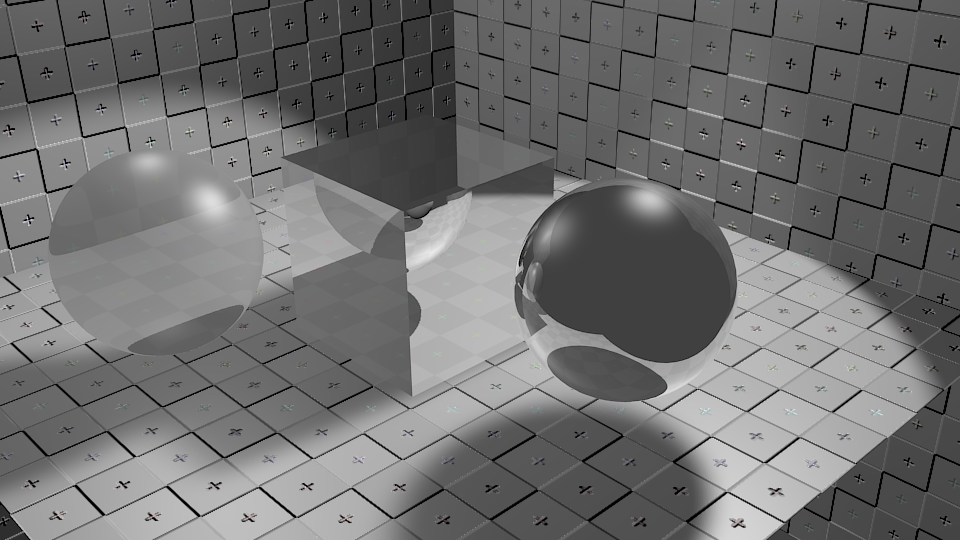
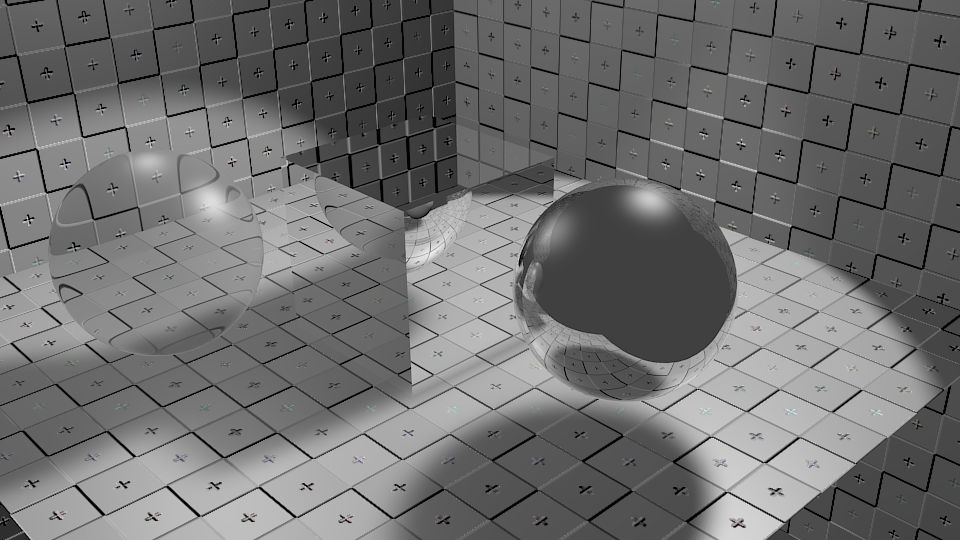
Raytracing didn't show soft shadow in reflections, nor did it do any
derivative even. Added a basic version for it in raytracer now, still
needs improvement on heavily curved surfaces. But it's better!

Examples:

Glass sphere, mirror cube and sphere, look how it ignores bump and shadow
http://www.blender.org/bf/derivative256.png

in svn now:
http://www.blender.org/bf/derivative-svn.png
also removed unused vars.

can_pbvh_draw() had a NULL check which is never needed (callers check for this), a NULL ob would have crashed the function anyway.
This problem was in both new bump and new new bump. The derivatives used for
bump mapping did not include the mapping, which gave mismatched offset for the
taps, now just do the mapping beforehand.
Many thanks to them!

For comparison, see here:
http://kishalmi.servus.at/3D/bumpcode/

Based on algorithm in: Mikkelsen M. S.: Simulation of Wrinkled Surfaces Revisited.
http://jbit.net/~sparky/sfgrad_bump/mm_sfgrad_bump.pdf

This fixes bugs:
#24591: Artefacts/strange normal mapping when anti-aliasing is on
#24735: Error at the Normal function.
#24962: Normals are not calculated correctly if anti-aliasing is off
#25103: Weird artefacts in Normal

This will break render compatibility a bit, but fixing this bugs would have also
done that, so in this case it should be acceptable.

Patch committed with these modifications:
* Bump method Old/3-Tap/5-Tap option in UI, 3-Tap is default
* Only compute normal perturbation vectors when needed
* Fix some middle of block variable definitions for MSVC
- convertblender.c, remove assignments to unused vars.
- readfile.c, fix 2 possible crashes. null pointers were being checked for then used later without checking.
- space_graph.c, use switch statement for automatic color assignment rather then a float array.
Compositor: "Read & Compo Full Sample Buffers" option stopped after
1 pass; the break callback was returning '1' falsely.

Also made it show "wait cursor" again, since it doesn't run in
thread nor updates UI while compositing buffers. Check console for
progress for now.
Compositor: Texture node didn't use texture-nodes itself.
Now composites initialize texture nodes correctly.

Also reviewed the fix for crashing texture nodes for displace.
It appears texture nodes also are used for sculpt/paint
brushes, in these cases it can be allowed again. But, don't
do this during rendering for now!
Hair render: using strand "Blender Unit" size didn't correctly
clip for larger/wider strands. Now code clips strands based
on the maximum width.

Also found bad code for using clipping flags, which was mixed up,
and probably caused hair strands to be missing in cases.
Material Node trees:
SSS wasn't displaying in Nodes.

Implementation notes:
- Currently copying local data for preview render, only copies
  the base material. Node materials are re-used.
- This causes data to be in 2 "main" databases... complex.
- To make it work for preview, I had to add another loop in the
  SSS code that checks the original Main dbase. That's marked
  as warning in code to be fixed up.

Another bug:
- Material properties "SSS presets" copied settings to the
  active material, not to the displayed one. Added RNA call
  to retrieve this from Objects.

(Next commit will fix preset scripts)
Preview render for node shaders broke, caused by localizing
materials last week, to prevent thread crashes. Fixed now.
Also added a temp fix to draw color-management corrected
node previews default. Will follow scene setting tomorrow.

Also: SSS in nodes doesn't render yet. Was issue in 2.4 too...
SSS preview render didn't happy.
Was caused by using a Material copy for preview renders (to prevent
crashing in other cases). There were actually 2 errors:
- material copy should be added to preview-main database
- the render was invoked using wrong main database even!
* Pointcache code was quite ugly looking and complicated, so here are mostly just cosmetic adjustments, but some improved logic also.
* Slight cleanup of pointcache ui too.
* Shouldn't have any functional changes what so ever, so poke me right away if something seems off.
When compositing without render (Enable composite, no renderlayer nodes)
the option Full Sample AA caused havoc. Added warning for this case
and gracefully stop render.
Old bug report:

Image Editor, Painting: crash when texture was visible in
Material or Texture preview. Was caused by paint code
freeing mipmaps. Now replaced with a mipmap tag (to be done
again), and a new mipmap function that doesn't re-allocate.
* Smoke is now only drawn/rendered after the simulation frame range starts.
* This does not apply to simulation end frame though, so that any remaining smoke can for example be faded away nicely through material settings.