Adds two modes of GPU frame capture support for
enhanced debugging. GPU frame capture begin/end
allow instantaneous frame capture of all GPU commands
within the capture boundary.

GPU frame capture scopes allow several user-defined capture
regions which can wrap key parts of code. These scopes are
exposed to connected GPU tools allowing the user to manually
trigger a capture of a known scope at the desired time.

This is currently integrated with the Metal backend for
support with Xcode.

Related to #105591

Pull Request: blender/blender#105717
Fix race condition if several competing threads are inserting Metal
buffers into the MTLSafeFreeList simultaneously while a new list
chunk is being created.

Also raise the limit for an MTLSafeFreeListChunk size to optimize
for interactivity when releasing lots of memory simultaneously.

Authored by Apple: Michael Parkin-White

Pull Request: blender/blender#105254
Optimized node graphs do not get cached and were
not correctly freed once their reference count reached
zero, due to being excluded from the GPUPass garbage
collection.

Also suppress Metal shader warnings, which are prevalent
during material optimization.

Authored by Apple: Michael Parkin-White

Pull Request: blender/blender#105795
Metal buffer binding validation would trigger an error
when a given shader had an empty PushConstantBlock.
This patch removes the default uniform code gen if
no uniforms are present, to avoid any possible issues
with buffers being bound to a shader where the destination
data block is size zero.

Authored by Apple: Michael Parkin-White

Pull Request: blender/blender#105796
Crash when selecting objects on AMD platforms running
Metal. This was caused by shader compilation warnings
being treated as errors in macOS 10.15. Wrapping
compilation failure with success check resolves error.

Authored by Apple: Michael Parkin-White

Pull Request: blender/blender#105739
immDrawPixels performs significantly slower in Metal
than OpenGL. This was caused by two main factors. Firstly,
the additional overhead of tiled texture update, where all
memory needed to be kept in flight for each update, but
caused update to take a slow path. Avoiding tile update
with Metal is more efficient for both memory pressure
and GPU pipelining.

Secondly, on AMD platforms, the staging buffer used
for temporary texture data was page-faulting when
several texture updates would occur within one frame.
This is due to limitations of allocating one large contiguous
memory chunk. Using the Metal buffer pool for staging
data is more efficient.

Authored by Apple: Michael Parkin-White

Pull Request: blender/blender#105794
Maximum distance of lines in screen space is limited. This limit seems
reasonable for FPS higher than 1, but UI allows to set 0.01 FPS with
soft. even lower values are possible.

This patch allows for normal operation within soft limits and labels are
still visible and quite usable within hard limits.

Pull Request: blender/blender#104849
Without assumptions of a mesh's direct ownership of its normals,
this was error prone, since normals could potentially be reallocated
when they are tagged dirty or retrieved with write access.
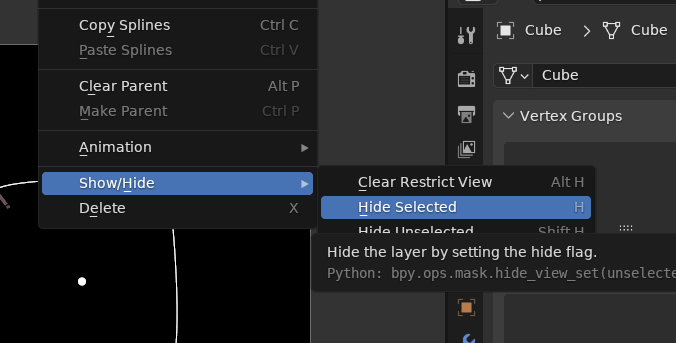
- Show/hide mask layers: the tooltip was confusing from a user's
perspective, because they should not be expected to know what a hide
flag is.
- Active Spline -> Active Point: likely a copy and paste error.
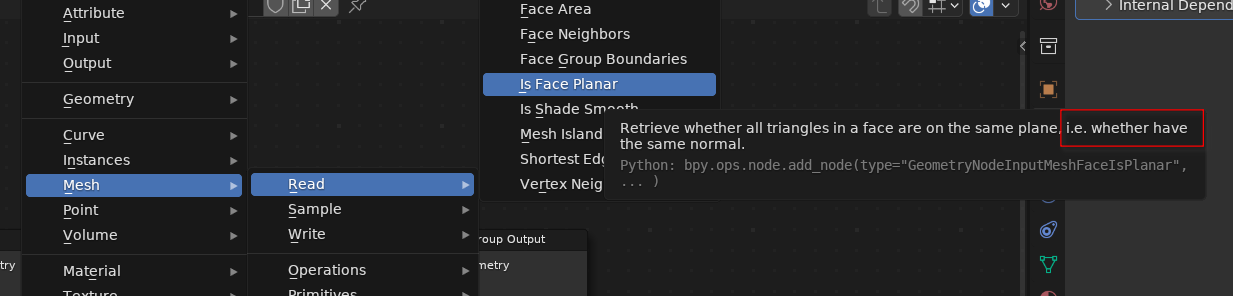
- Geo Nodes face is planar node: forgotten article.
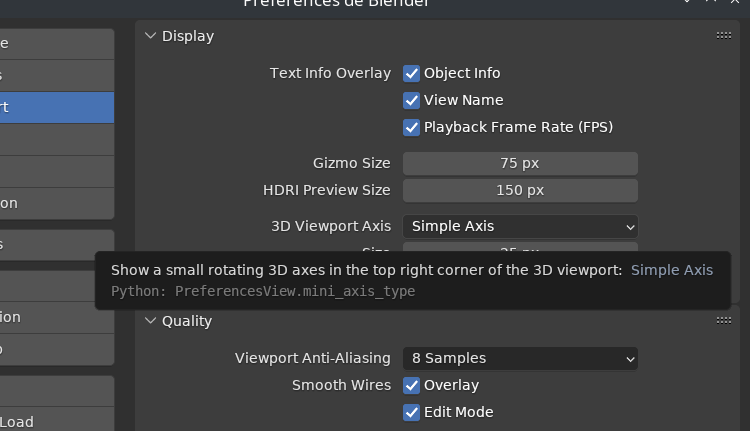
- Axes, plural instead of axis for the viewport preferences. Here
there are several usages of axis or axes. Since they refer to
coordinate axes I believe they should be plural, even though the
property `mini_axis_type` is still wrong.
-----
Pull Request: blender/blender#105814
No functional changes.

This is just a micro-optimization to avoid updating `prev_point` and
calling `ED_gizmotypes_snap_3d_data_get` when snapping is not enabled.
The bug only happened in wireframe mode.

Originally the `const bool use_depth` indicated when projection should
be done on invoke.

Later it started to indicate when to snap on invoke.

But with keymap snap detection, using this `use_depth` is no longer
correct.
Implement the two cached normal accessors with C++ methods
directly. This avoids dealing with raw pointers and reduces the
amount of casting necessary.
Since normals are derived data, it's always a change to something
else that will cause them to change, like the winding order of a face
or vertex positions. So it's clearer to use tags for those things
directly. It's correct to remove the tag in one place since dirty is
the default state of a new mesh.
This validation dates back to when vertex normals were stored in
the `MVert` type (before cfa53e0fbe). Since normals
are all calculated in the same place, and aren't saved in files, this
isn't relevant anymore-- they can just be recalculated.
When creating the bounding box mesh for the viewport replacement,
copy the material from the original mesh. I'm not sure if Cycles is
meant to load materials from the original mesh or the Alembic file
itself, but either way, this should be a harmless change and fixes the
issue in the report.

Pull Request: blender/blender#105798
Create GPUNodeLinks for tiled_image and tiled_image_mapping together, to ensure they are the same texture.

See blender/blender#105661 (comment) for context and a more in-depth explanation.

Pull Request: blender/blender#105772
... or carnidal interpolation with only 2 color stops.

This was triggering an incorrect path due to missing optimisation cases.
Just fall back to the unoptimized case fixes the assert.
This was likely caused by a bad merge when doing the uniform name
patching for Metal.
This also fix the same issue for active UDIM tile overlay which wasn't
reported.
eaa87101cd made evaluated metaballs become meshes
for render engines. This exposed the normals calculated by the metaball
tessellation directly, whereas before they were recalculated later.

There are two fixes: not using the metaball tessellation normals at
all and calculating them with the standard Mesh code path instead,
or switching a define in the metaball code to use a more mesh-like
vertex normal accumulation. Since the results are very similar
(see attached renders), use the second solution, which should
be less expensive.

Pull Request: blender/blender#105799
Increase the default value for the maximum number of recently-opened
files from 10 to 20. Also change the user's preference on version bump
to this new value if their current value is exactly the old default.

Pull Request: blender/blender#105703
When the height of the editor couldn't fit the sidebar tabs, they would shrink
to a size too small to read the tab label.

This change matches the behaviour with the Properties Editor navigation bar,
by introducing the following improvements:
* Avoid truncating tab labels.
* Allow scrolling when tabs don't fit.

Behaviour is similar to how scrolling works in the Properties Editor navigation
bar, supporting mouse wheel up/down and MMB, and switching tabs with
`Ctrl+Wheel Up/Down`.

Pull Request: blender/blender#105355
My PR blender/blender#104535
was committed as 88f9c55f7f and the logic was changed
while adding support for face sets, making the logic incorrect and
the warning system disfunctional.
Restore the logic from the original PR with added support for face sets,
fix const correctness issues, improve variable naming, and remove a
check for empty names, since all attribute-type layers should have
names in a valid mesh.
Fixes#105780
Previously only the icon of a file could be dragged in the list display
modes, the name label would invoke box select. This made dragging quite
finicky. I've seen this cause quite some frustration, especially when
the file browser is used as a regular editor to drag data from into
other editors.

Instead follow the Outliner (and some other file browsers like the macOS
one): Dragging on empty space invokes box select, dragging on the name
or icon invokes drag & drop of the item.

The hitbox for the dragging is the width of the string, and the full row
height. So there's no space between rows to do box-select from, it
always triggers dragging. This is based on feedback during testing.

Note that 1e9564864c and 6da512f0bc were needed to prepare this change.

Pull Request: #104830
The switch from `stroke_start` to `vertex_start` in 8c6d4aa103 forgot
to also update `iter->stroke_index_last` which also needs to use
`vertex_start`.

Pull Request: blender/blender#105797
Skip explicit binding location for samplers in OpenGL when not needed, since drivers can usually handle more sampler declarations this way (as long as they're not actually used by the shader).

Pull Request: blender/blender#105770
Skip explicit binding location for samplers in OpenGL when not needed, since drivers can usually handle more sampler declarations this way (as long as they're not actually used by the shader).

Pull Request: blender/blender#105770


