* Fix SDL not finding Xlib.h
* Link to clangSupport library for newer LLVM versions
* Add FreeBSD essential symbols to symbols_unix.map

Pull Request: blender/blender#105892
* With the move to gitea, .gitea doesn't need to be copied into installs.
* Add .github and .gitignore in more places for future proofing.
* Deduplicate ìnstall_dir macro.

Co-authored-by: Brecht Van Lommel <brecht@blender.org>
Pull Request: blender/blender#105980
Workaround for compiler issue on AMD
platforms resulting in the erroneous
discarding of valid rays in fragment
raytracing.

Authored by Apple: Michael Parkin-White

Pull Request: blender/blender#105967
Fixed a bug where the active color wasn't being set
on imported meshes, resulting in no colors displaying
in the viewport.

This bug has been in the code for a long time. However,
the colors have been displaying correctly until recently,
so this issue wasn't previously apparent.

Also, changed custom color data name from "displayColors"
to "displayColor", to match the actual USD primvar name.
(This was a typo in the original code.)

Note that pull request

blender/blender#104542

addresses other issues in the color import code (e.g.,
converting all color primvars and not just "displayColor",
avoiding hard-coding of attribute names, handling all
iterpolation types, etc.).

However, the current commit is meant as a short term fix
to a regression, where the "displayColor" attribute does
not render in the viewport at all, until the above pull
can be merged.
133dde41bb changed how 'fake user' flag is handled with linked data.

Previous behavior was a bug/inconsistency, in that the 'directly linked'
tag would be 'over-set' and never cleared, forcing saving references to
a lot of unused linked data.
Note that ideally, 'Fake user' flag should be ignored, and the only way
to decide whether to keep or not a linked ID should be whether it's
actually used by some local data.

However, #103867 and #105687 show that this is causing issues in some cases,
where users wrongly relied on the linked data's pre-defined 'Fake user' flag
to keep their linked data in their production files, even if said data had no
real user.

While not ideal, for now we should consider 'fake user' flag for linked data
as a real usage case. A better handling of this edge-case is related to
wider designs aboud handling of 'non used' data on file save, whether
linked IDs should keep track of being explicitly or implicitly linked by
the user, etc.
The NLA's behaviour of always forcing a full set of keys (XYZW) is now
done in both 'Combine' and 'Replace' mode (previously only the former).

This fixes the bug where quaternions could not be properly keyed in 'full
stack tweak mode' under certain conditions.

Pull Request: blender/blender#105604
The `NODE_OT_link_viewer` operator has some complicated logic that was
intended to stop cycling through geometry nodes to make it work better
with nodes that have multiple geometry and data outputs (group nodes).
This logic failed when geometry was not the first socket and it would
just stop connecting data sockets altogether after the geometry socket.

The reason is that the `determine_socket_to_view` function stops looking
for already-viewed outputs after the first geometry, and then simply
reconnects that geometry.

This patch changes the behavior slightly so that, if a geometry output
is found, the node skips over all subsequent geometry outputs, but still
considers data sockets for viewing. Viewing a node with multiple geometry
outputs will connect the first geometry output it encounters and then
keep cycling through data outputs on repeated execution.

Pull Request: #105836
In a previous step of the mesh writing process, the loop `totlayer` was
replaced and a temporary vector is used for layer data instead. Use this
temporary vector to find the UV sub-layers, since the vector and the
CustomData struct in the mesh don't necessarily match. Also use a
local variable for mesh loop count to make it clearer that the mesh
isn't used except at the end.

Thanks to Campbell for finding the source of this error.
There were logic errors and use-after-free errors with the attribute
removal function. Because the custom data layers are reallocated,
we can't reuse the name pointer after removing an attribute. And
we can't return early on the first domain to fail for the edit mode
implementation, because another domain might have the attribute.

Also reorganize some of the code to make the logic clearer: only remove
sub-attribuutes and change attribute names after actually removing the
attribute,and  assert if the attribute isn't removed after it is found.
The crash is fixed by reverting 87fd798ae3 and
some follow up commits. While it would generally be nice to move to a more
SoA format for these things, we are not there yet and this is causing more
trouble than it's worth currently. The main difficulty is that the socket
indices are changed by many different operations which invalidates the array
too often and led to many follow up bugs.

Pull Request: blender/blender#105877
Follow connections when reading the varname attribute of a primvar
reader, and support both string and TfToken types for the varname.

A unit test is also provided.

Authored by Apple: Matt McLin

Pull Request: blender/blender#105508
This was lost in the refactor to store material indices in a generic attribute.
The attribute API still allows this, but that will be handled separately
since it's a more complex task. The existing API that already clamped
input values should still do that.
Other areas like blenkernel and Cycles clamp the material indices to be
positive so this should be consistent with them. There is still discussion
if material indices should be made impossible, but this at least avoids
crashing for the 3.5 release.

There was also an inconsistency in how sculpt mode handles material index
higher than the number of slots.

Ref #105577
This flag is moved to a different variable but the default value is still placed on the wrong variable.

This fixes the default value assignment but due to the old flag bits are in conflict with used bits in the new flag variables, versioning changes are not included.

Pull Request: blender/blender#105852
When multiple nodes (Frame nodes included in the selection) are scaled/
rotated, the TransData location and center can get "wrong" due to the
fact that Frame nodes dont only use `locx`/`locy` for their
representation while drawing, but also `offsetx`/`offsety`.

So in order to use the "real" top-left corner in the transform system,
we have to respect `offsetx`/`offsety` when creating/flushing transform
data.

In addition to the file in the report, this patch was also tested to work
well with nested Frame nodes.

Pull Request: blender/blender#105400
Viewer node paths usually start with the modifier, but in pinned
node editors the tree may not be used by the object in context.
In that case the modifier part of the path should be ignored.
The viewer node is always disabled in that case.

Pull Request: blender/blender#105826
Resizing an image via the operator did not mark it dirty
(`IB_BITMAPDIRTY` is needed to pick this up as being modified, if this is
not set, no warning/option is shown on file close).

Note that using RNA would already do this correctly (since it uses
`BKE_image_scale` -- which already calls `BKE_image_mark_dirty`
internally).

Pull Request: blender/blender#105851
While **marking** an asset would update the Outliner immediately (this
due to the fact that `ED_asset_generate_preview` indirectly took care of
a refresh), **clearing** an asset would not do this.

Now be explicit about this in the Outliner listener and consider asset
notifiers there.

Pull Request: blender/blender#105287
Preview render depsgraphs are put in the depsgraph registry
concurrently with other threads. This was lacking a mutex lock
and a map value that remains unchanged when other elements of
the map are updated.

Pull Request: blender/blender#105839
When an object has no UV layers and an anonymous UV layer is created,
the anonymous layer gets set as the default (render) layer. This is
very confusing because it then uses a hidden anonmous layer. This patch
suppresses the usage of anonymous layers for rendering.

Pull Request: blender/blender#105192
`scissor_test_set` wasn't able to parse the arguments that were
passed correctly, due to incorrect control data during functino
registration.

This patch uses the correct control data during registration and
is able to parse arguments.

Ref: #104911

Pull Request: blender/blender#105850
Auto-depth is no longer reset during consecutive touch-pad motion.

Details:

- Add wmEvent::flag, WM_EVENT_IS_CONSECUTIVE to detect consecutive
  track-pad & NDOF motion events. Expose via RNA as Event.is_consecutive.

- Consecutive events are broken by button/key presses and mouse motion.

- Add `WM_event_consecutive_data_*` functions, so operators can store
  data between consecutive events.

- Add `ED_view3d_autodist_last_*` functions to access the last autodist
  pivot point for view operators to use.
This is an issue revealed by the recent optimization in 4d3bfb3f41 to have
CPU and GPU subdivision topology both cached.

BKE_subsurf_modifier_subdiv_descriptor_ensure is what (re)creates the
topology refiner when needed. Invalidating the topology refiner on changes
must be done before it, otherwise we end up with an incomplete Subdiv that
either does not draw or draws incorrectly.

Pull Request: blender/blender#105844
Various UI code would store the `AssetHandle` in a way that turns out to
be unsafe. The file-data is part of the file browser caching system that
releases file-data when a certain maximum of items is in the cache. So
even while just iterating over the assets, earlier iterated asset
handles may become invalid. Now asset handles are really treated as
volatile, short lived objects.
For the asset-view, the fix was more involved. There we need an RNA
collection of asset-handles, because the UI list code requires that. So
we create a dummy collection and get the asset handles as needed by
index. This again meant that I had to keep the index of the collection
and the asset-list in sync, so all filtering had to be moved to the UI
list.
I tried duplicating the file-data out of the cache instead, but that
caused problems with managing the memory/ownership of the preview
images.
`AssetHandle` should be removed and replaced by `AssetRepresentation`,
but this would be an even more disruptive change (breaking API
compatibility too).
Fixes#104305, #105535.
Pull Request: #105773
Fix race condition if several competing threads are inserting Metal
buffers into the MTLSafeFreeList simultaneously while a new list
chunk is being created.

Also raise the limit for an MTLSafeFreeListChunk size to optimize
for interactivity when releasing lots of memory simultaneously.

Authored by Apple: Michael Parkin-White

Pull Request: blender/blender#105254
Optimized node graphs do not get cached and were
not correctly freed once their reference count reached
zero, due to being excluded from the GPUPass garbage
collection.

Also suppress Metal shader warnings, which are prevalent
during material optimization.

Authored by Apple: Michael Parkin-White

Pull Request: blender/blender#105795
Metal buffer binding validation would trigger an error
when a given shader had an empty PushConstantBlock.
This patch removes the default uniform code gen if
no uniforms are present, to avoid any possible issues
with buffers being bound to a shader where the destination
data block is size zero.

Authored by Apple: Michael Parkin-White

Pull Request: blender/blender#105796
Crash when selecting objects on AMD platforms running
Metal. This was caused by shader compilation warnings
being treated as errors in macOS 10.15. Wrapping
compilation failure with success check resolves error.

Authored by Apple: Michael Parkin-White

Pull Request: blender/blender#105739
immDrawPixels performs significantly slower in Metal
than OpenGL. This was caused by two main factors. Firstly,
the additional overhead of tiled texture update, where all
memory needed to be kept in flight for each update, but
caused update to take a slow path. Avoiding tile update
with Metal is more efficient for both memory pressure
and GPU pipelining.

Secondly, on AMD platforms, the staging buffer used
for temporary texture data was page-faulting when
several texture updates would occur within one frame.
This is due to limitations of allocating one large contiguous
memory chunk. Using the Metal buffer pool for staging
data is more efficient.

Authored by Apple: Michael Parkin-White

Pull Request: blender/blender#105794
Maximum distance of lines in screen space is limited. This limit seems
reasonable for FPS higher than 1, but UI allows to set 0.01 FPS with
soft. even lower values are possible.

This patch allows for normal operation within soft limits and labels are
still visible and quite usable within hard limits.

Pull Request: blender/blender#104849
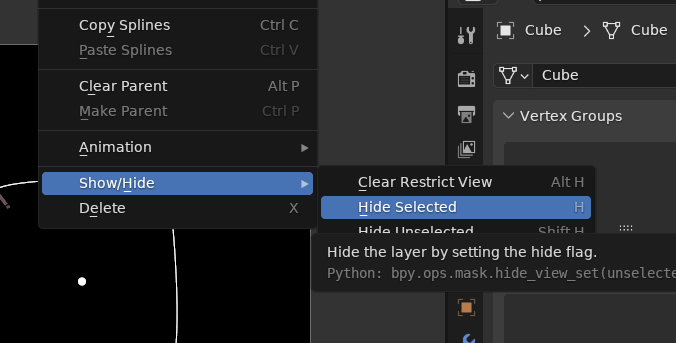
- Show/hide mask layers: the tooltip was confusing from a user's
perspective, because they should not be expected to know what a hide
flag is.
- Active Spline -> Active Point: likely a copy and paste error.
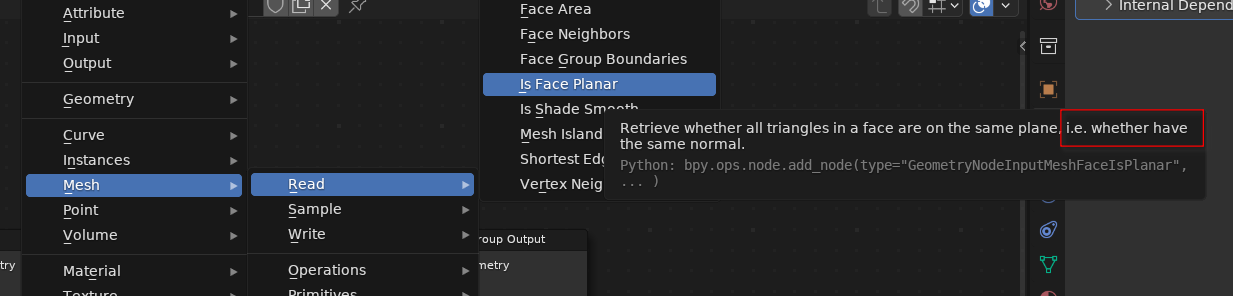
- Geo Nodes face is planar node: forgotten article.
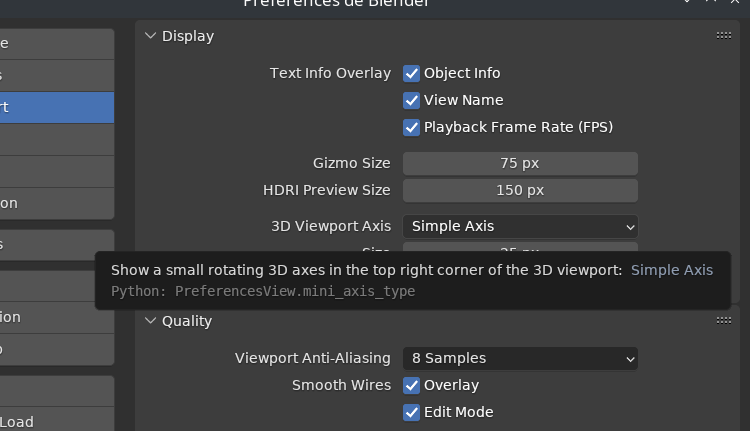
- Axes, plural instead of axis for the viewport preferences. Here
there are several usages of axis or axes. Since they refer to
coordinate axes I believe they should be plural, even though the
property `mini_axis_type` is still wrong.
-----
Pull Request: blender/blender#105814
The bug only happened in wireframe mode.

Originally the `const bool use_depth` indicated when projection should
be done on invoke.

Later it started to indicate when to snap on invoke.

But with keymap snap detection, using this `use_depth` is no longer
correct.
When creating the bounding box mesh for the viewport replacement,
copy the material from the original mesh. I'm not sure if Cycles is
meant to load materials from the original mesh or the Alembic file
itself, but either way, this should be a harmless change and fixes the
issue in the report.

Pull Request: blender/blender#105798
... or carnidal interpolation with only 2 color stops.

This was triggering an incorrect path due to missing optimisation cases.
Just fall back to the unoptimized case fixes the assert.
This was likely caused by a bad merge when doing the uniform name
patching for Metal.
This also fix the same issue for active UDIM tile overlay which wasn't
reported.
eaa87101cd made evaluated metaballs become meshes
for render engines. This exposed the normals calculated by the metaball
tessellation directly, whereas before they were recalculated later.

There are two fixes: not using the metaball tessellation normals at
all and calculating them with the standard Mesh code path instead,
or switching a define in the metaball code to use a more mesh-like
vertex normal accumulation. Since the results are very similar
(see attached renders), use the second solution, which should
be less expensive.

Pull Request: blender/blender#105799
My PR blender/blender#104535
was committed as 88f9c55f7f and the logic was changed
while adding support for face sets, making the logic incorrect and
the warning system disfunctional.
Restore the logic from the original PR with added support for face sets,
fix const correctness issues, improve variable naming, and remove a
check for empty names, since all attribute-type layers should have
names in a valid mesh.
Fixes#105780
The switch from `stroke_start` to `vertex_start` in 8c6d4aa103 forgot
to also update `iter->stroke_index_last` which also needs to use
`vertex_start`.

Pull Request: blender/blender#105797
Skip explicit binding location for samplers in OpenGL when not needed, since drivers can usually handle more sampler declarations this way (as long as they're not actually used by the shader).

Pull Request: blender/blender#105770
The loading for the "All" asset library would include the "Current File"
library as if it were a regular asset libray on disk. Instead make sure
the latter is loaded properly first and is skipped when recursively
reading on disk libraries.



